
Modern custom homes involve complex coordination between design teams, builders, and clients. Understanding how technology enforces construction project transparency is becoming essential for managing this complexity responsibly.
Architects, building designers, and interior designers invest significant time shaping a project’s layout, proportions, materials, and detailing so the final home responds thoughtfully to both the client and the site.
By the time a project reaches construction, hundreds of design decisions have already been made.
The challenge is ensuring those decisions survive the transition from drawings to the building site.
Construction inevitably introduces new pressures — structural requirements, site conditions, compliance considerations, and practical building constraints. Without careful coordination, even well-resolved designs can begin to shift during this stage.
This is why the relationship between the builder and the design team becomes so important.
A successful project is not simply about constructing what appears on the drawings. It is about guiding the design through construction in a way that respects the original intent while responding intelligently to the realities of the site.
When the builder, the design team, and the client remain aligned, the construction phase becomes a continuation of the design process rather than a departure from it.
Key Takeaways
- Relying on scattered spreadsheets and delayed financial reporting creates unnecessary stress and budget anxiety for clients.
- Modern construction technology creates a “single source of truth,” allowing architects and clients to access live project data 24/7.
- Systemising Work Health and Safety (WHS) compliance allows the site team to focus entirely on building your home efficiently.
- True construction project transparency is achieved through disciplined digital workflows.
Why Technology and Builder–Designer Collaboration Matters
Achieving true construction project transparency when executing a bespoke architectural home is a highly complex logistical exercise. It requires managing thousands of moving parts, coordinating intricate trade sequences, and tracking highly precise financial data. As you will know from [Link to: Article 09] understanding your custom home building contract, managing this complexity safely requires rigid documentation.
Historically, the construction industry managed this using scattered spreadsheets, paper invoices, and disconnected phone calls. For a modern, high-value project, this outdated approach is a recipe for errors, budget blowouts, and immense client stress. Today, a successful build requires more than just excellent craftsmanship; it requires a robust technological infrastructure.
As outlined in our previous articles, open-book visibility is the ultimate risk management tool. However, transparency is not a slogan — it must be structurally enforced. This is where digital systems become essential. This article explores how modern, fully integrated ecosystems are transforming the building experience, replacing guesswork with real-time data to provide total clarity for clients and architects alike.
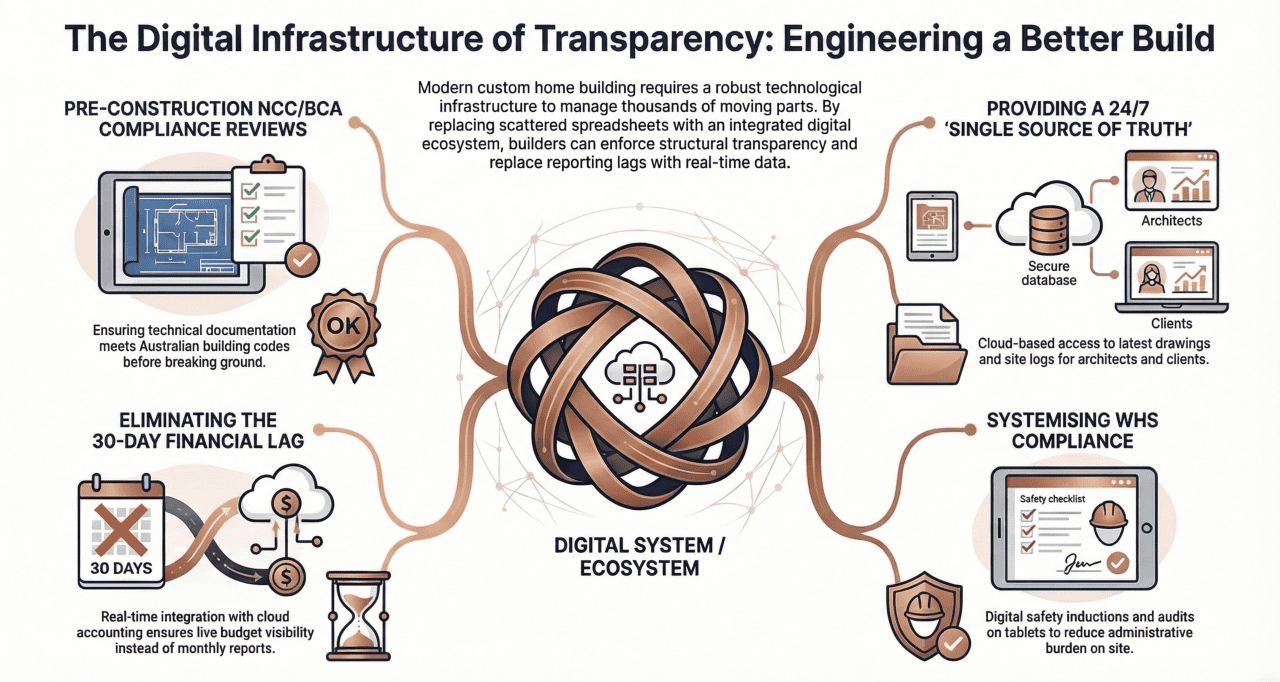
De-risking the design with pre-construction compliance reviews
One of the greatest pressures on modern design teams is the increasing regulatory burden of the National Construction Code (NCC) and the Building Code of Australia (BCA – now part of the NCC). With recent legislative changes enforcing stricter design liabilities, navigating compliance and Australian Standards can quickly become overwhelming for architects and clients alike.
This is where a disciplined technological infrastructure begins adding value long before we break ground.
During the pre-construction phase, we utilise our digital systems to work directly with the design team, conducting comprehensive NCC and BCA constructability reviews. Rather than leaving the architect to shoulder the compliance burden alone, we cross-check architectural details against current building codes within a shared digital environment. We proactively identify potential regulatory gaps, waterproofing complexities, and structural code requirements early. By collaboratively resolving these details before construction starts, we ensure the design intent is not only protected, but also ready to build.
The end of the 30-day financial lag
Without disciplined financial visibility, even well-designed projects can drift into stress and distrust. We believe that financial transparency is the single most critical element of a calm, predictable build. Yet, a common failure in traditional construction is a severe lag in financial reporting.
In the past, clients were often left waiting for a 30-day, end-of-month spreadsheet to find out where their budget stood. By the time that report arrived, the financial reality on site had already moved, leaving clients feeling vulnerable and out of control.
Today, advanced construction management platforms are fully integrated with cloud-based accounting software. This means that the moment a trade partner submits an invoice, or a materials receipt is captured on site, it is instantly processed and allocated to the project’s live dashboard. Rather than looking at last month’s numbers, clients can log in and see their exact financial position today. This real-time integration completely eliminates financial ambiguity, driving construction project transparency and empowering clients to make decisions, or approve design upgrades, with absolute confidence.
The “Single Source of Truth” and 24/7 access
When project information lives in different places—an email in the architect’s inbox, a text message on the builder’s phone, and a paper plan on the site—miscommunication is inevitable. This is especially true when navigating the inherent limitations of plans and documentation. Without a unified system, site supervisors and trades are left to interpret fragmented information, leading to delays, rework, and compromised design intent.
To combat this, professional builders now utilise cloud-based platforms that act as a “single source of truth.” In governance terms, this creates evidentiary continuity. Schedules, daily site logs, and critical updates are captured instantly from the field using mobile technology.
This is particularly transformative for the architect. A major friction point in custom building is ensuring that the trades on site are working from the most up-to-date drawings. Because the platform is a live digital environment, the architect does not have to rely on phone tag to check on progress. They can log in securely from their studio at any time to review live site photos, answer Requests for Information (RFIs), and verify that the team is building from the absolute latest architectural revisions. This seamless, 24/7 collaboration prevents the costly errors that occur when communication lags.
Operational efficiency and uncompromising safety
A well-managed site is a safe site. However, managing rigorous Work Health and Safety (WHS) obligations can often become an administrative burden that slows down physical construction. Traditional compliance methods rely on physical logbooks and paper sign-ins, which are prone to damage, loss, and auditing difficulties.
By deploying dedicated digital safety systems, modern builders can streamline this vital compliance. Site inductions, Safe Work Method Statements (SWMS), and daily safety audits are processed quickly and efficiently via tablets on site. Systemising these requirements minimises the time staff must spend on paperwork, ensuring their focus remains exactly where it should be: driving the project forward, maintaining uncompromising safety standards, and ensuring continuous construction project transparency.
How digital systems enforce construction project transparency
In recent years the construction industry has begun adopting integrated project management platforms that replace fragmented spreadsheets and paper-based administration. These systems consolidate scheduling, financial tracking, documentation, and communication into a single environment.
The adoption of digital construction systems significantly improves coordination between project stakeholders while reducing administrative errors and budget uncertainty. For complex architectural homes—where precision and clarity are essential—this digital infrastructure has become a cornerstone of responsible project delivery.
Engineering out the friction
While we utilise industry-leading software at Simpson & Co, the discipline with which we configure and enforce these systems is what differentiates professional operators from reactive ones. When evaluating a professional builder, their operational maturity and digital infrastructure should be heavily scrutinised. We have engineered a highly specific digital workflow, deliberately structured to manage the specific pressures of high-value residential construction.
Ultimately, deploying tools that enforce construction project transparency is not just about “going paperless.” It is about operational governance. By building a robust digital framework that rapidly processes data, eliminates human error, and communicates transparently, we engineer out the traditional friction of a custom build. The result is a highly professional, collaborative experience from the first estimate to the final handover.
Behind the scenes, delivering this level of construction project transparency requires disciplined operational systems. Cost tracking, scheduling, document management, and site communication must all integrate into a single workflow. When these systems operate correctly, they create a reliable structure where financial reporting, architectural coordination, and construction progress remain aligned. For clients, this simply means fewer surprises and greater confidence that the project is progressing exactly as intended.
Project Intelligence: Quick Q&A
How do escarpment and coastal site logistics impact the cost and timeline of an Illawarra custom build?
Building between the Illawarra escarpment and the ocean introduces unique access, engineering, and environmental constraints that standard builds never face. Steep slopes require heavy civil engineering, specialised retaining structures, and meticulous overland water management plans. Coastal blocks demand strict marine-grade material specifications to prevent early corrosion, along with complex staging plans handled by Luke on-site to safely manage tight delivery windows on narrow coastal roads.
What structural safeguards are required when building on a steep escarpment slope?
Constructing on a slope requires comprehensive geotechnical intelligence, deep concrete piling, and continuous structural stability monitoring. Rather than relying on superficial brick-and-slab techniques, architectural homes on the escarpment are anchored directly into stable substrate or bedrock. Resolving these heavy engineering and retaining parameters early ensures that the structural core of your home remains completely secure against slope movement and soil shifting over its lifetime.
Why must material selections be altered when building within a frontline marine zone?
Frontline marine environments subject building envelopes to extreme wind loads, high salt crystallisation, and accelerated atmospheric corrosion. Standard fasteners, structural steel framing, external claddings, and window suites will rapidly degrade if they are not explicitly rated for marine exposure. We mitigate these environmental risks during our pre-construction procurement phase by sourcing high-performance stainless steel alloys, specialised coatings, and resilient hardwoods engineered to withstand the harsh coastal climate.
Explore further resources on how process influences your custom build:
- Article 04 — What Plans and Specifications Don’t Always Show
- Article 08 – How to Evaluate a Custom Home Builders True Value
- Article 09 – Custom Home Building Contracts Explained: Risk, Cost & Clarity
- Article 10 — Transparency in Custom Home Building: The Ultimate Risk Management Tool
Enforce transparency with digital precision. True project transparency must be structurally enforced by modern digital systems. To see how our real-time cost tracking and communication platforms can provide total visibility over your custom build, get in touch with our team today.